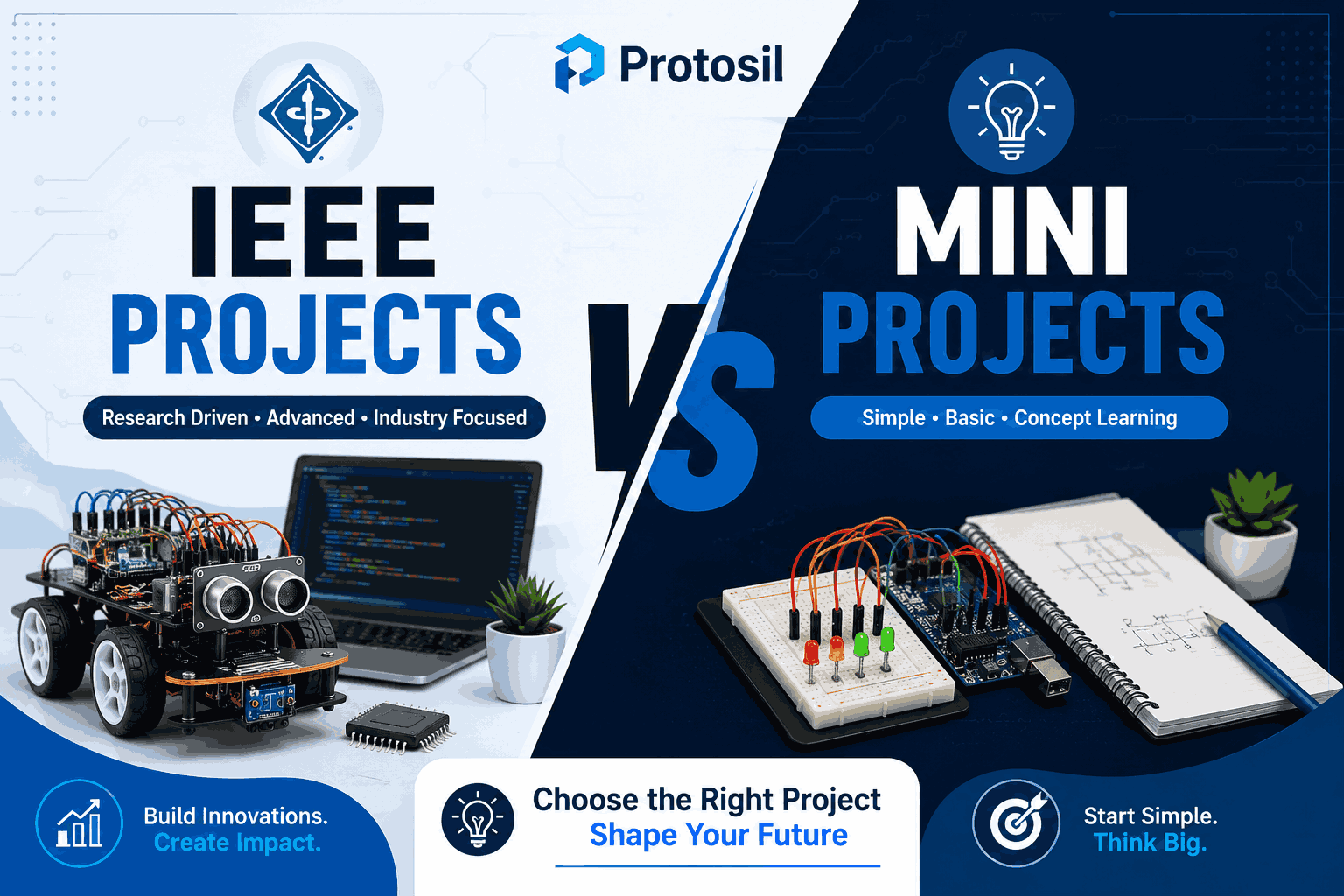
Engineering students often face one common question before starting their academic project: Should I choose an IEEE Project or a Mini Project? While both project types help improve technical knowledge, they differ significantly in complexity, learning outcomes, implementation, and career value.
Understanding these differences will help you choose the right project based on your academic goals, technical skills, and future career plans.
At Protosil, we guide engineering students in selecting projects that match their branch, skill level, and industry requirements, ensuring they gain practical experience beyond classroom learning.
What Are Mini Projects?
Mini Projects are small-scale engineering projects designed to help students understand fundamental concepts and basic implementation techniques. They are generally completed during the early semesters and focus on learning core technologies.
Mini projects usually involve:
- Basic hardware implementation
- Simple software development
- Fundamental programming concepts
- Limited project documentation
- Short development timelines
These projects are excellent for building confidence before working on larger and more complex academic projects.
What Are IEEE Projects?
IEEE Projects are developed by referring to research papers published by the Institute of Electrical and Electronics Engineers (IEEE). These projects are based on the latest technologies and research trends, making them highly valuable for final-year engineering students.
IEEE projects typically include:
- Research-based implementation
- Advanced technologies
- Industry-oriented problem solving
- Detailed documentation
- Performance analysis
- Future enhancement possibilities
Because they are inspired by real research, IEEE projects provide students with practical exposure to current engineering challenges.
IEEE Projects vs Mini Projects
Feature | IEEE Projects | Mini Projects |
Project Level | Advanced | Beginner |
Best For | Final Year Students | Early Semester Students |
Research Scope | High | Basic |
Industry Relevance | Excellent | Moderate |
Documentation | Detailed | Basic |
Implementation | Complex | Simple |
Placement Value | High | Medium |
Learning Outcome | Extensive | Foundational |
When Should You Choose a Mini Project?
A Mini Project is a good option if you:
- Are in the early semesters of engineering.
- Want to strengthen programming or hardware basics.
- Are learning a new technology.
- Need a short-duration academic project.
- Want hands-on experience before attempting larger projects.
Mini projects help students build confidence while improving practical knowledge.
When Should You Choose an IEEE Project?
IEEE Projects are recommended if you:
- Are in your final year.
- Want to improve placement opportunities.
- Plan to pursue higher studies.
- Want exposure to research-based technologies.
- Are interested in innovative engineering solutions.
Students who complete IEEE projects often gain deeper technical knowledge because they work on real-world engineering problems.
Which Project Has Better Career Value?
From a career perspective, IEEE Projects usually provide greater value because they demonstrate your ability to understand advanced technologies, analyze research problems, and implement practical solutions.
Recruiters often discuss final-year projects during interviews. A well-executed IEEE project can showcase your technical skills, analytical thinking, and practical experience.
However, Mini Projects should not be underestimated. They help students build the foundation required for successfully completing advanced engineering projects in later semesters.
How Protosil Helps Students
Choosing the right project can significantly impact your academic performance and career growth. At Protosil, we help students identify project domains that match their interests and future goals.
Our support includes:
- IEEE project guidance
- Final year project assistance
- Project topic selection
- Technical mentoring
- Documentation support
- Implementation guidance
- Research-oriented project solutions
We focus on helping students develop practical, innovative, and industry-ready engineering projects.
Final Thoughts
Both Mini Projects and IEEE Projects play an important role in engineering education. Mini Projects help students understand core concepts, while IEEE Projects prepare them for research, innovation, and professional careers.
If you are a final-year engineering student aiming for placements, higher studies, or technical expertise, choosing an IEEE Project is generally the better option. With the right guidance and implementation support, your project can become a valuable addition to your academic portfolio.
Frequently Asked Questions - IEEE Projects
No. The requirement depends on your university, but many institutions encourage IEEE-based projects because of their research value.
Mini Projects are generally easier because they focus on basic concepts, while IEEE Projects involve advanced technologies and detailed implementation.
Yes. IEEE Projects demonstrate practical knowledge, research exposure, and technical problem-solving skills, making them valuable during placements.
Yes. Protosil provides expert guidance for selecting, developing, and implementing IEEE Projects, Mini Projects, and Final Year Engineering Projects based on your academic requirements.